7 Tips for Buying Alumina Ceramic Nozzles
Alumina Ceramic Nozzles are chosen for demanding jobs where abrasion resistance and dimensional stability matter. Yet a nozzle that performs well in one setup may wear quickly or restrict flow in another. The difference often comes down to details: the abrasive being used, operating pressure, temperature, nozzle geometry, and the fit with existing equipment.
This guide shares seven practical points to check before buying. Start with the working conditions, not just the product name. Compare bore diameter, inlet and outlet dimensions, ceramic grade, and the supplier’s stated tolerances. Ask for technical data and, where available, test results or material documentation. A catalog rating is useful, but it may not match your actual process. It is worth checking.
Consider how the nozzle will be installed and replaced, too. A precise ceramic component can still disappoint if its holder is poorly matched or routine inspection is overlooked. If possible, test a sample under representative conditions and record flow, wear, and service life. Small differences can matter. No single specification guarantees a good result, and supplier claims should be weighed against evidence from your application. These tips are intended to help buyers ask clearer questions, compare options fairly, and avoid choosing on price alone. A little uncertainty remains until the nozzle is tested in the real setup.
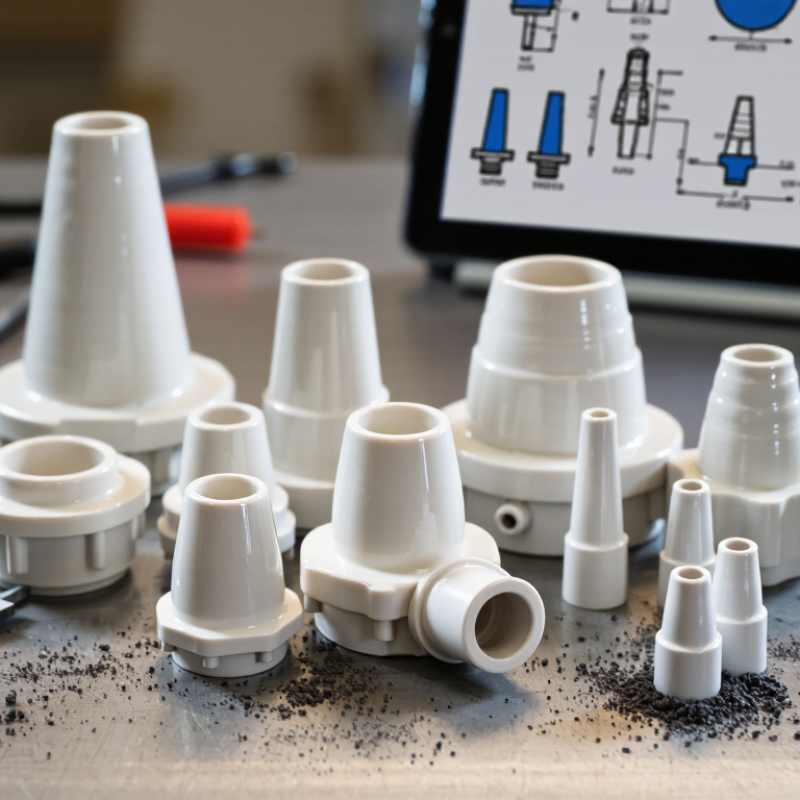
Define Nozzle Duty by Operating Pressure, Temperature, Flow, and Abrasion
Start with the nozzle’s actual duty, not just its inlet size. Record operating pressure at the nozzle, including peaks during startup or valve changes. Compare that range with the rated limits of the complete assembly, not the ceramic component alone. Alumina resists wear, but brittle ceramic can crack under impact or uneven clamping. Small details matter. Note the highest sustained temperature and any rapid heating or cooling cycles. Thermal shock can matter as much as the maximum temperature.
Flow requirements shape bore diameter, exit profile, and pressure loss. A narrow throat may increase jet velocity, yet it can also raise clogging risk when the feed contains coarse particles. Use the actual fluid or gas, solids loading, and target flow when discussing sizing. For abrasive service, identify particle hardness, size, concentration, and impact angle; each can influence wear patterns. Inspect a worn nozzle, if available. Uneven enlargement near the outlet may indicate a mismatch between the flow path and particle trajectory. Keep records of pressure, temperature, and service hours. Operating data may be incomplete, so state assumptions clearly and verify them during a controlled trial.
Select Alumina Purity: 95–99.9% Al₂O₃ for Different Wear Requirements
For alumina ceramic nozzles, purity is a useful starting point, not a wear-life guarantee. A 95% Al₂O₃ grade can suit moderate abrasion and cost-sensitive service. In highly abrasive flow, 99–99.9% grades are worth comparing because they can offer greater hardness and lower impurity content. Check the actual test data. NIST’s evaluated α-alumina properties report a density of about 3.98 g/cm³ and an elastic modulus near 400 GPa; these figures describe the material, not a nozzle’s service life (NISTIR 6853, 2002). Small distinction. It matters.
Ask suppliers for measured hardness, bulk density, open porosity, and grain size for the specific grade. ASTM C1327 provides a standard method for measuring advanced ceramic Vickers hardness, making comparable test results more useful than purity claims alone. Nozzles face different conditions: sharp particles, flow speed, pressure, and impact can change wear dramatically. A 99.9% nozzle may not outperform a well-made 95% part if its geometry or finish is poor. Inspect the bore and outlet closely; rough edges can concentrate erosion. I would match purity to the abrasive load, then trial the nozzle under real operating conditions. It’s easy to over-specify. Some wear data also comes from different test setups, so compare the methods before trusting the numbers.
Compare Material Data: 3.7–3.9 g/cm³ Density and 15–20 GPa Hardness
For alumina ceramic nozzles, treat 3.7–3.9 g/cm³ density and 15–20 GPa hardness as screening ranges, not guarantees. Ceramic property tables, including those in ASM Handbook, Volume 4A: Ceramics and Glasses, show why grade and microstructure matter. A denser nozzle may resist pore-related wear, but density alone does not prove longer service life. Ask for the measured value, test method, and batch report.
Hardness figures are meaningful only when the test conditions match. ASTM C1327 specifies Vickers indentation testing for advanced ceramics; compare reports using the same method and load. Small differences matter. A nozzle near 15 GPa may still suit a low-impact application, while abrasive particles can quickly expose weaknesses in surface finish or porosity. Check the nozzle’s bore under bright light: tiny chips around the inlet can disturb flow and grow during use. I would also question unusually high hardness claims without a test report. They may reflect different methods, not better material. Density and hardness help narrow choices, but fit, wall thickness, and operating conditions still deserve a close look.
7 Tips for Buying Alumina Ceramic Nozzles - Compare Material Data: 3.7–3.9 g/cm³ Density and 15–20 GPa Hardness
Note: Values are representative ranges for dense alumina ceramics, not guaranteed specifications. Actual properties vary with composition, manufacturing process, test method, and component design. Request current grade-specific test data before ordering.
Specify Bore Geometry and Tolerances to Maintain Consistent Flow
For an alumina ceramic nozzle, bore geometry is a flow-control feature, not a cosmetic detail. Under laminar conditions, the Hagen–Poiseuille relationship predicts flow is proportional to bore diameter raised to the fourth power. A 1% diameter change can therefore shift predicted flow by roughly 4%, assuming other conditions stay constant. Crane Technical Paper 410, Flow of Fluids, provides an engineering reference for flow calculations. Small shifts matter. This estimate does not apply unchanged to turbulent flow or particle-laden fluids.
Specify the minimum and maximum bore diameter, roundness, straightness, and surface finish on the drawing. ISO 286-1:2010 offers a recognized system for dimensional tolerances, but a general tolerance class may not be tight enough for a flow-critical nozzle. Ask the supplier how bore size is measured and where measurements are taken. A single reading at the entrance can miss taper deeper inside the part.
Also state the operating fluid, pressure range, and temperature. Alumina is rigid, yet firing and finishing can leave subtle variation between the inlet and outlet. A practical inspection plan might check several positions along the bore and retain measured results by lot. One awkward detail: tighter tolerances can raise cost without improving performance if the process itself varies. Set limits from the required flow window, then verify them with test data.
Check Toughness and Thermal Shock: Typical Fracture Toughness Is 3–5 MPa·m½
Alumina ceramic nozzles are hard and wear-resistant, but they can still fracture under impact or rapid temperature change. Typical fracture toughness is about 3–5 MPa·m½, depending on composition and test method. This value describes resistance to crack growth; it does not guarantee a nozzle will survive every thermal cycle. A sharp edge, uneven wall thickness, or tight mounting fit can create extra stress. Small details matter.
Tip: Compare toughness values only when the test methods are similar. Ask for the material grade, test standard, and relevant quality data. Thermal shock resistance also depends on thermal conductivity, expansion, nozzle shape, and temperature difference. A datasheet number alone can leave gaps.
Before selecting a nozzle, consider its real operating cycle: how quickly it heats, how it is cooled, and whether flow changes abruptly. Check whether the supplier has tested parts under conditions close to yours. During installation, avoid forceful tightening and inspect for chips around the inlet and outlet. A toughness figure is useful, but I would not treat it as a complete prediction. The comparison is imperfect. If failures occur, record temperatures and mounting details; those clues may reveal a problem that the material rating misses.